
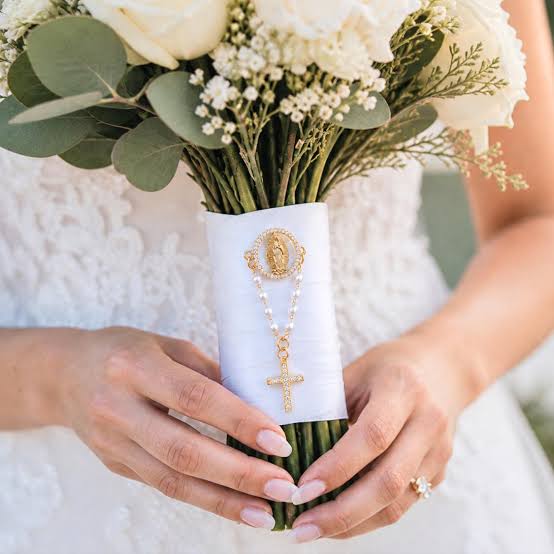
7 Beautiful Catholic Wedding Traditions to Consider for Your Wedding Mass
Your Catholic wedding Mass is more than a celebration of your love story. It is a sacred sacrament, a covenant with God, and the beginning of your life together as husband and wife. While the Nuptial Mass is rich with beautiful prayers, Scripture readings, and sacred rituals, many Catholic couples also choose to incorporate additional traditions that reflect their faith, heritage, and devotion.
From honoring Our Lady to exchanging symbolic gifts that represent unity and abundance, these traditions can add a deeply personal touch to your wedding day while keeping Christ at the center of your marriage.
Before finalizing your ceremony, confirm the meaning and origin of the custom/s, with your priest or the appropriate cultural community, especially if you plan to incorporate a tradition that is unfamiliar in your parish.
If you are planning a Catholic wedding, here are seven beautiful traditions to inspire you:
1. Flowers to Mary: Honoring Our Blessed Mother
One of the most beloved traditions in many Catholic weddings is the presentation of flowers to the Blessed Virgin Mary. This special moment is an opportunity for the bride to honor Our Lady and ask for her prayers and intercession as she begins her vocation to marriage.
Mary is a beautiful example of faith, humility, trust, and complete surrender to God's will. By honoring her on your wedding day, you can ask her to guide you and your husband as you build a Christ-centered marriage.
Often, the bride approaches a statue or image of Mary, accompanied by a hymn or Marian prayer, and places a bouquet of flowers at her feet. Some couples choose to include the Salve Regina or a Marian hymn like 'Ave Maria' during this moment.
2. The Wedding Rosary: A Prayer for Your Marriage
The Rosary is a treasured Catholic devotion that invites us to meditate on the life of Jesus through the eyes of His Blessed Mother. Incorporating a wedding Rosary tradition can be a beautiful reminder for a couple that prayer should remain at the heart of their marriage.
Marriage is filled with joyful moments, challenges, sacrifices, and opportunities to grow in holiness. The Rosary can become a source of comfort and a way for husband and wife to turn to God together through every season of life.
Depending on family or cultural custom, a wedding Rosary may be presented to the bride and groom, held or draped around their hands, or used as part of a special prayer or blessing. Some couples also choose to pray the Rosary together before the wedding (back-to-back and seated so as not to see one another) or have their rosary blessed during Mass.
3. The Crucifix: Keeping Christ at the Center of Your Marriage
For Catholic couples, the Crucifix is a powerful symbol of the love that makes Christian marriage possible: the self-giving love of Jesus Christ.
The Crucifix reminds us that authentic love is not simply a feeling. It is a daily decision to give of ourselves, forgive one another, practice patience, and seek the good of our spouse.
As you begin your marriage, the Crucifix can serve as a reminder that Christ is not merely a guest at your wedding but the foundation upon which you are building your life together.
Some couples incorporate a special family Crucifix into their wedding day. It may be blessed, carried in the procession where permitted, displayed near the couple, or used in a private prayer. In certain families, the Crucifix is also passed down from one generation to the next, making it a treasured heirloom that connects the newlyweds with the faith of their parents and grandparents.
Another beautiful option is to keep a Crucifix in your home and make it the focal point of your family prayer space.
4. Stefana Crowns: A Beautiful Eastern Christian Tradition
For couples celebrating an Eastern Christian wedding, particularly within the Chaldean or Byzantine Catholic traditions, the crowning ceremony is one of the most meaningful moments of the marriage liturgy.
Known as the Stefana in Greek tradition, the wedding crowns are placed on the heads of the bride and groom by the priest. They may be connected by a ribbon and exchanged over the couple's heads during the ceremony, depending on the particular tradition.
The crowns symbolize the couple's new life together, their unity, and their calling to a shared life of faith, sacrifice, and holiness. They can also represent the couple's willingness to embrace the joys and challenges of marriage with Christ at the center.
5. The Lasso: A Symbol of Unity and Lifelong Commitment
The wedding Lasso is a beautiful tradition associated with Mexican, Filipino, and other Latin American and Hispanic Catholic communities, although its customs differ from family to family.
During the ceremony, a cord or large Rosary is placed around the shoulders of the bride and groom, often in the shape of a figure eight. The Lasso is typically placed over the couple after their vows, and it remains there during a prayer or blessing.
The circular or figure-eight shape is commonly understood as a symbol of everlasting love and the unbreakable bond created through marriage. It also represents the couple's unity as they begin their new life together.
Many Lasso cords are intricately decorated with flowers, pearls, crystals, or religious medals. Some are family heirlooms passed down through generations, while others are chosen to match the couple's wedding aesthetic.
6. Arras: The Exchange of Wedding Coins
The Arras tradition, also known as the wedding coins ceremony, is especially associated with Hispanic and Filipino Catholic weddings, among other communities.
During this custom, the groom traditionally presents the bride with a set of thirteen coins, often placed in a decorative tray or small box. In some celebrations, the coins are exchanged or received in a slightly different manner according to local custom.
The coins represent the couple's commitment to sharing their material resources and caring for their household. The thirteen coins are often associated with Christ and the twelve apostles, although interpretations vary by culture and family.
Beyond their material value, the coins symbolize trust, generosity, responsibility, and the promise that the couple will work together to provide for their family.
Marriage involves more than an emotional and spiritual union. It also means sharing everyday responsibilities, making financial decisions together, and using material blessings with generosity and wisdom.
The Arras ceremony offers a tangible reminder that a Catholic marriage calls husband and wife to be good stewards of what God has entrusted to them.
7. Carrying an Icon of Mary: Inviting Our Lady Into Your Wedding Day
For Catholic brides who have a special devotion to the Blessed Virgin Mary, another beautiful tradition is to have a flower girl or another member of the wedding party carry an icon of Mary in the wedding procession instead of a traditional basket of flowers.
Rather than scattering flower petals, your flower girl can carry a small, beautifully framed Marian icon as she walks down the aisle. Alternatively, a bridesmaid, a young family member, or another member of the wedding party can carry the icon reverently in the procession.
This is a particularly meaningful option for brides who wish to honor Our Lady in a visible way from the very beginning of their wedding ceremony. The icon can depict Mary under a title especially dear to the couple, such as Our Lady of Guadalupe, Our Lady of Perpetual Help, or the Immaculate Heart of Mary.
For couples who hope to build a marriage centered on Christ, this gesture can serve as a reminder of Mary's words at the wedding feast of Cana: “Do whatever he tells you” (John 2:5). Her words beautifully express the heart of a Catholic marriage: following Jesus together and trusting in His grace.
The icon can also become a cherished keepsake after the wedding. You might display it in your home prayer corner, place it near your family Crucifix, or use it as a focal point for praying the Rosary together as a married couple.
--------------
As you consider these beautiful customs, remember that your Catholic wedding is first and foremost a sacrament. The additional traditions you choose should deepen your understanding of marriage, reflect your faith, and honor your family heritage without distracting from the sacred liturgy.
Here are a few things to keep in mind as you plan:
- Speak with your priest early. Some traditions are established parts of particular Catholic marriage rites, while others are local devotions or cultural customs. Your priest can help you determine what is appropriate for your ceremony.
- Choose traditions that are meaningful to you. You do not need to include every custom. One or two thoughtfully chosen traditions can be more meaningful than trying to incorporate everything.
- Honour your family's heritage. Ask your parents, grandparents, or other relatives about the traditions they grew up with. You may discover beautiful customs that have been practiced for generations.
- Understand the symbolism. Knowing the meaning behind each tradition will make it more prayerful and personal, rather than simply another wedding detail.
- Consider the liturgical guidelines. A Roman Catholic Nuptial Mass follows a prescribed order, and customs should be coordinated with the priest. Traditions that cannot be incorporated into the Mass may still be celebrated at another appropriate time.
Your wedding day is the beginning of a lifelong vocation. While the flowers, music, dress, and reception will make the day memorable, the deepest beauty of a Catholic wedding lies in the sacrament itself: the promises you make before God and the grace He gives you to live them out.
The most beautiful traditions are those that point beyond the wedding day and toward the marriage you hope to build: one rooted in prayer, strengthened by sacrifice, enriched by family, and centered on Jesus Christ.
May your wedding day be the beginning of a joyful and holy marriage, and may the traditions you choose serve as lasting reminders of the promises you make before God.
For further advice on incorporating any of these traditions, get in touch and we will be very happy to help whether it is wording it correctly in your Mass booklet, finding a couple's rosary (where two rosaries are bound together at the head) or knowing which flowers are most beautiful in their symbolism.